
The International Monetary Fund (IMF) warned on Tuesday that India's general government debt (comprising both central and state government debt) could exceed 100 per cent of gross domestic product (GDP) in the medium term. It also cautioned that long-term debt sustainability risks are high due to the significant investment required to meet India's climate change mitigation targets. The Indian government, however, disagreed, arguing that risks from sovereign debt are extremely limited as it is predominantly denominated in domestic currency.

'India's emergence as a top crypto market comes despite a regulatory and tax environment that can be challenging for the industry to navigate.'

Chief Economic Advisor (CEA) V Anantha Nageswaran considers absolute poverty a more direct and pressing concern for India. He argues that inequality is a relative concept. Simultaneously, with formerly economically deprived sections joining the ranks of the middle class, policy attention needs to extend beyond 'roti, kapda, makaan' to keep the growth engine up and running.

But the government will present a second tranche of Supplementary Demands for Grants during the Budget session of Parliament in February, when it can seek additional spending.

If states have to fall in line with MSPs declared by political parties, they will have to do so in violation of central order or bear the full expense of the surplus procured at above MSP rates.

India's import of personal computers, including laptops and tablets, shot up in September by 42 per cent to $715 million, reversing a year-long downward trend after the government announced it would impose import restrictions on such electronic hardware items in August. The rise in such imports were led by the largest source China (33 per cent) and Singapore (188 per cent), according to data released by the commerce department. On August 3, the Centre had announced it was planning to bring seven products in the information technology hardware segment, such as personal computers, micro computers, mainframe computers, super computers, computer systems and data processing units under the 'restricted' label.

The government has exhausted only 39 per cent of its fiscal deficit target in the first half of FY24.
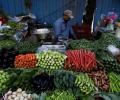
Higher growth in vegetable demand relative to supply in the recent past has led to an upward trend in inflation, with spikes becoming more frequent. A study by rating agency Crisil found that vegetable inflation has been the most volatile in the food category, in fact. Inflation volatility is detrimental for both consumers and farmers and also sidetracks policymakers in the short term, necessitating frequent and repeated price-smoothing measures.

Extreme poverty in India declined by 38 million in 2021 to 167.49 million after a surge in the two preceding years, but remained above the 2018 level, the latest World Bank data shows. While for most countries poverty rose in 2020, when the Covid-19 pandemic hit the global economy, the data shows poverty shot up in India a year earlier in 2019 to 176.09 million from 151.79 million in 2018, the lowest pre-pandemic count. India's poverty rate at 11.9 per cent in 2021 also remained higher than the 2018 level of 11.09 per cent, though easing from 14.72 per cent in 2020.

The government's decision to impose a 20 per cent export duty on parboiled rice and a $1,200 per tonne minimum export price (MEP) on basmati rice has pulled down overseas shipments of the former by almost 83 per cent and around 30 per cent of basmati exports in a month. Data sourced from various trade agencies and shippers showed that between August 25 and September 20, export of basmati rice has shrunk from 342,605 tonnes in 2022 to around 241,083 tonnes in 2023. Similarly, export of parboiled rice, after the imposition of 20 per cent duty during the same period, has dropped from 1.16 million tonnes in 2022 to just around 204,190 tonnes in 2023.

'The assessment of most people is that there is a stable economic and political environment in India and that is attractive to investors.'
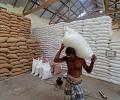
Amid the ongoing festival season and ahead of the elections for five state assemblies, the Centre is closely monitoring inflation, particularly in food items, to enable it to take steps to increase their supplies. "There is a complete no-nonsense attitude when it comes to food inflation, and instructions have been issued at all levels to be very sensitive to any possible price movements in any commodity," a senior official explained. Sources have said that all departments dealing with food items have been instructed to keep a close eye on all commodities and maintain a weekly record of their price movements.

The Centre, for the first time, has initiated a draft proposal for setting up an All India Institute of Medical Sciences (AIIMS)-like institute of national importance for animal health, education and research in Delhi to be called the All India Institute of Veterinary Sciences (AIIVS).
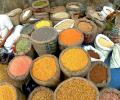
After a steady surge, prices of pulses, except those of urad and masoor to some extent, are showing signs of stabilising amid a revival of monsoon rains over major growing areas of Maharashtra and Karnataka, and on expectations of a rise in imports. Chana prices, which too had moved up in recent months, have dropped by almost 3 per cent since the end of August due to increased liquidation of government stocks, official data shows. Monsoon rains seem to have benefitted the standing soybean crop as well.

'To get a 100 per cent consensus document without any reservation, any bracket, any chair summary is unprecedented in the history of multilateral forums.'

India's recent move to remove additional 'retaliatory' duty on eight products from the United States (US), including apples and walnuts, would not have any negative impact on the domestic producers, the government clarified, even as the issue threatened to snowball into a political slugfest between the ruling and Opposition parties. The move would, in fact, result in competition in the premium market segment, ensuring better quality at better prices for consumers, especially for apples, a senior government official said. "There were certain concerns that were being raised on the mutually agreed solution that has come in, more specific to seven-eight agriculture products where we had levied additional import duties in retaliation to the steel and aluminum measures (imposed by the US)," Peeyush Kumar, additional secretary in the commerce department, told reporters in a briefing.

'I'm pitching India for the strengths we offer, including the English language, engineers, doctors, nurses, professionals, innovative talent of startups.'

In the coming months, globally as well as in India, rice might remain a hot potato.

An exhibition on the origins of Indian art, culture, handicrafts, and India's grassroots farming innovations is scheduled for September 9 and 10.

Even before NCP-Ajit Pawar leaders came to meet in Delhi, the central government decided to buy 200,000 tonnes of onions from farmers at Rs 24.1 per quintal. This was among the highest prices at which onions have ever been bought from farmers.
 © 2025 Rediff.com - Investor Information - Advertise with us - Disclaimer - Privacy Policy - Sitemap - Feedback - About us - Terms of use - Grievances